
-180x100.png)
Piglets are very vulnerable in their first days of life. At first, their bodies cool down at a rate of 1-2 degrees per minute if they are not kept warm. At a body temperature of 34°C, piglets stop suckling milk, lose energy and become susceptible to disease. Newborn piglets do not yet have a developed thermoregulation system. Therefore, warmth is not only about comfort for them, but also the basis for healthy growth and development.
Why is heating piglets so important?
Since piglets' skin has almost no subcutaneous fat, it is difficult for them to retain heat on their own, which, by the way, supports stable digestive system function, stimulates milk and feed consumption, reduces the risk of diarrhoea and inflammation, and boosts immunity.
According to research, the right temperature in the nest can prevent animal mortality. And this directly affects the farmer's wallet.
Optimal temperature for piglets of different ages
In fact, the temperature for piglets should vary depending on the age of the animals. In the first days of life, they are heated intensively, and then the temperature is gradually reduced to stimulate natural thermoregulation.
| Age of piglets | Indoor temperature, °C | Temperature under the lamp, °C | Recommendations |
| 0–3 days | 30–32 | 34–35 | Highest heat demand |
| 4–7 days | 28–30 | 32–33 | Reducing power or raising the lamp |
| 8–14 days | 26–28 | 30–31 | Beginning of adaptation |
| 15–21 days | 24–26 | 28–29 | Gradual decrease in temperature |
| 22–30 days | 22–24 | 26–27 | Formation of thermoregulation |
| After 1 month | 20–22 | 24–25 | The heating can be gradually removed |
The role of lamps in heating piglets
Perhaps the most convenient way to heat piglets is with lamps. They provide heat and can be used to precisely regulate the temperature in the area where the piglets are located. This is important when the sow is nearby, as adult pigs do not tolerate heat well. Lamps for heating animals allow you to create a ‘microclimate within a microclimate’, i.e. maintain a comfortable temperature only where it is needed for newborn piglets, without overheating the entire room.
In addition, the lamps are easy to use, easy to install above the nest, and easy to adjust the hanging height and lighting angle. The farmer can quickly change the position of the lamp to maintain the desired temperature in the rest area. For example, when the piglets grow and need less heat, the lamp is simply raised higher or turned on for only a few hours a day.
It is also important to pay attention to the correct positioning of the lamp. The optimal height is 50–70 cm above the floor or nest surface. The temperature in the centre of the heating area should be around 32–34 °C for newborn piglets, and 4–6 degrees lower towards the edges of the zone so that the animals can choose a comfortable place for themselves.
Types of heating lamps
Modern models of heating lamps differ in power, radiation spectrum and efficiency. They are infrared, ceramic, halogen, incandescent lamps, and IR panels. Let's take a closer look at the most popular ones.
Infrared lamps are in high demand because they provide soft, directed heat that warms the animal's body rather than the air around it. They quickly warm piglets, reduce the risk of colds and promote better feed intake.
Ceramic heaters do not emit light, so they are ideal for night-time use, do not disturb the sow and provide uniform heat throughout the day.
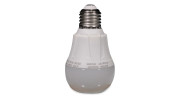
LED or combined systems with thermostats allow you to automatically maintain a set temperature, which reduces electricity consumption and eliminates the risk of overheating.
Halogen lamps are an improved version of conventional incandescent lamps. They contain halogen gas inside, which allows the filament to operate at a higher temperature and increases heat transfer. These lamps are compact, durable and quickly heat the area below them. Their advantage is stable heat and natural light, which helps piglets orient themselves in space. At the same time, it should be noted that halogen lamps heat up quite strongly, so they need to be kept at a safe distance from animals and flammable materials.
Incandescent lamps are the most affordable but least efficient heating option. They create soft, diffused heat, but a significant portion of the energy is spent on light rather than heating. Such lamps are appropriate for use as a temporary solution or in small rooms where there is no need for a powerful heat flow. It is important to remember that conventional incandescent lamps have a short service life and are not designed for long-term continuous operation.
An IR panel is a modern alternative to traditional lamps. It emits long-wave infrared heat, which is evenly distributed across the floor or socket surface. Such panels do not dry out the air, do not create bright light and operate completely silently.
| Lamp type | Principle of operation | Features | Advantages | Disadvantages |
| Incandescent lamp | Illuminates and partially heats the air | A simple solution for short-term use | Cheap, affordable | Low heat output, burns out quickly |
| Halogen lamp | Creates concentrated thermal radiation | Provides directed, adjustable heat | Energy efficient, durable | Can dry out the air |
| Ceramic lamp | Emits only heat, no light | Suitable for long-term use | Long-lasting, does not irritate the eyes | Higher price |
| Infrared lamp (IR) | Emits infrared heat similar to the sun | It's not the air that warms up, but the animal's body. | The most effective solution for piglets | Requires proper installation |
| IR panel | Heats the area evenly from below or above | Soft warmth, suitable for large rooms | Safe, economical | High cost, complicated installation |
Advantages of infrared heating
Infrared lamps for heating piglets are the golden mean on farms today. They do not heat the air, but transfer heat directly to the animals, like the sun's rays. This way, the piglet warms up faster, even if it is cold around it.
Infrared heating lamps distribute heat quickly and evenly without drying out the air in the room. Piglets feel good, have a good appetite and gain weight well. In addition, these lamps help reduce mortality in young animals by 50-70%. . To ensure a comfortable microclimate in the pigsty, it is worth buying infrared lamps — they quickly warm up the piglets and reduce the risk of hypothermia.
| IR lamp type | Material | Features | Service life | Recommended use |
| Red glass lamp | Heat-resistant glass | Emits a soft light that is comfortable for the eyes | 3–6 months | For newborns |
| Clear glass lamp | Clear glass | Has stronger light, warms up quickly | 3–6 months | For short-term heating |
| Ceramic IR lamp | Ceramics without light | Does not give light, only heat | До 2 years | For long-term use |
| Halogen IR lamp | Glass with halogen | Allows you to adjust the heat intensity | 1–1,5 years | For zone heating |
How to choose and correctly install an infrared lamp
For an infrared lamp to work effectively, certain nuances must be taken into account.
- Lamp parameters: 150-250 W is usually sufficient to heat one nest.
- Installation height: the optimal height is 50-70 cm from the floor. If the lamp hangs too low, the piglets may overheat; if it hangs too high, the desired effect will not be achieved.
- Heating area: the lamp should cover the entire area evenly.
- Safety: be sure to use protective platforms or grilles so that animals cannot touch the lamp.
- Temperature control — choose a lamp with a thermostat to help control the microclimate.
You can buy lamps for heating pigs in the online store ‘VADA’ — a company specialising in engineering solutions for livestock and poultry farming, including pig farms. The VADA catalogue includes red, ceramic and halogen IR lamps of various power ratings, as well as equipment for a complete heating system for piglets, sows and young stock. Lamps for heating pigs help maintain the optimum temperature even in the cold season, which is why farmers are increasingly choosing infrared models as the most effective solution.
If you are looking for a solution that combines efficiency, economy and reliability, choose infrared lamps for heating piglets. They will help your little ones stay warm, healthy and grow well even on the coldest days.
20/10/2025