







-180x100.png)
 Filters
Clean water without any hassle: nipple drinkers for rabbits
Rabbits are very clean animals. They cannot tolerate dirt in their cages and need plenty of fresh water every day. But any bowl quickly turns into a "swamp" with hay and feed. That is why farmers are increasingly choosing nipple drinkers — a modern, smart and hygienic way of watering that solves most problems at once.
What are nipple drinkers for rabbits, and why are they needed?
This is special equipment for watering rabbits, which supplies water in drops only when the animal touches the nipple — a small metal pin or ball inside. This drinker is connected to a water container or a central water supply system. As soon as the rabbit releases the nipple, the water stops dripping. With this watering principle, the cages remain dry, water is used sparingly and does not stagnate in open containers.
Nipple drinkers have long been used in pig and poultry farming, and are now becoming popular in rabbit breeding.
Advantages of nipple drinkers for rabbits
Let's take a closer look at why farmers are increasingly choosing nipple drinkers for rabbits.
- Clean water — in this type of drinker, the water is protected from dirt, thereby reducing the risk of disease and infection.
- Economy — water consumption is minimal because it does not spill or evaporate.
- Convenience for staff: there is no need to change dirty water from bowls every day — it is enough to refill the common container with water or check the system once every few days.
- Hygiene in cages — with nipple drinkers, the area remains dry and clean.
- Convenient to use in both large and small farms.
- Easy to scale — connecting the drinkers to a single common water line makes the system virtually automatic.
Nipple drinkers for rabbits are truly effective equipment for rabbit breeding.
How to choose nipple drinkers for rabbits
To make your choice easier, let's take a look at the nuances of these drinkers.
The material of the drinkers is important. Stainless steel (especially for fittings and nipples) is considered the best option — it is durable, does not rust, is easy to maintain and does not release toxic substances. Materials are often combined, but it is important that the nipples are made of steel. As for plastic, it is cheaper and lighter, but rabbits can chew on it, and plastic parts can crack over time.
Nipple diameter: for rabbit drinkers, slightly larger nipples or a special fountain are usually installed so that the animal can easily grasp it with its teeth or nose. There are low-pressure models and regular ones — for pressurised systems. Before use, check how easily water flows with little effort.
Number of drinkers: for small groups or home keeping, calculate a minimum of 1 nipple per cage with 2-3 animals so that there is no queuing. For industrial breeding, you can also install the same number. But if you have doubts about whether it will be enough, it is better to install more than less.
Type of installation. For cage systems, clip brackets or fountains that clip onto the bars are used. The nipple is mounted at a height that is convenient for the rabbit to drink. For floor or enclosure systems, nipples are installed in the side wall or on stationary wooden or metal partitions. In larger groups, PVC pipes or rigid risers with fittings are used. In such cases, additional fasteners are often required.
The angle of the nipple is also important: rabbits are more comfortable when it is installed at a slight angle or horizontally. If the nipple faces downwards, some animals may have difficulty drinking water due to discomfort.
Height — the drinker should be placed at the level of the rabbit's chest/muzzle.
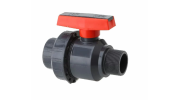
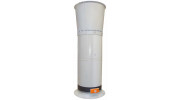
Separate additional elements enhance the function of nipple drinkers. In particular, drip collectors collect drops that flow out during drinking, thus keeping the bedding dry. Water filters must be used if the water has sediment, and they will protect the nipples from clogging. In large systems, filters are installed at the inlet to the main line and washed from time to time. Thanks to check valves, ball valves and fittings, air will not enter the line. With them, you can shut down the system section by section for cleaning.
Recommendations for using nipple drinkers for rabbits
- It all starts with planning and design. Draw a diagram of the rows of cages: where the tank/reservoir will be located, where the main line will go, where the openings for the nipples will be.
- Select the components: nipples for rabbits, pipe, drip cups, fittings, tap/drain valve at the end of the row.
- Install the reservoir — the water source. For a gravity system, the tank is installed above the level of the cages to create the required static pressure. A pump may be required for large systems.
- Install a filter and pressure regulator at the inlet.
- Next, lay the main line and attach the pipes. The pipe should lie at a minimum slope so that it can be easily flushed.
- Install nipples and drip collectors.
- Check the system under pressure: open the water supply, go through the row and test each nipple. Adjust the pressure with the regulator.
- Secure and protect against gnawing with special racks or a thin plate.
- Now you need to teach the rabbits to drink water from this system. Wet the nipple with your finger so that a drop appears on it — the animal will try it and learn.
How to properly maintain nipple drinkers? Inspect them daily: check for leaks, make sure all nipples are closed, and that all animals are drinking water. Once a week, flush the lines and inspect the filters. Every month, check and, if necessary, clean the mechanical filter, inspect all fittings and clips, and replace springs and seals as needed. Once a year, perform a complete overhaul of all equipment.
Where to buy nipple drinkers for rabbits in Ukraine?
Choose equipment for rabbits from VADA — it is, first of all, profitable, because we have affordable prices; fast, because we have our own delivery service in Ukraine; and reliable, because we offer high-quality equipment for rabbit breeding from trusted manufacturers. We offer various models of drinkers, modern drinking bowls for rabbits, accessories, etc. Our experienced specialists will advise you and help you choose effective solutions for your farm.